
Office Address
45 Ivan Allen Jr Blvd NW
Atlanta, GA 30308
Phone Number
+1 (888) 808-7330
Email Address
General: [email protected]
Sales: [email protected]
Support: [email protected]

45 Ivan Allen Jr Blvd NW
Atlanta, GA 30308
+1 (888) 808-7330
General: [email protected]
Sales: [email protected]
Support: [email protected]


 by Trurion Staffs
Reading time: ~9 minutes | Audience: CISOs, SOC leadership, vulnerability management owners
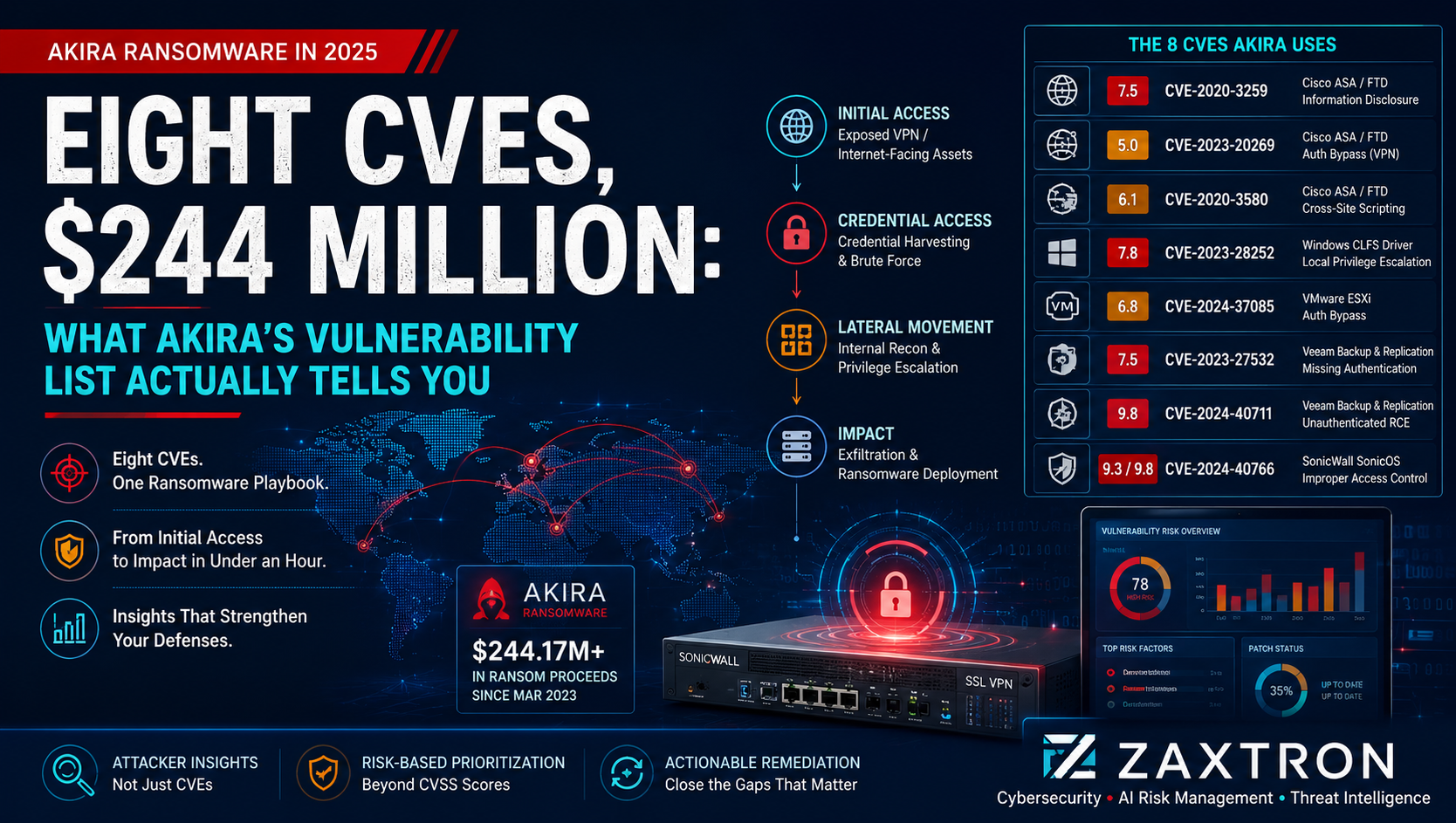
When the FBI, CISA, DC3, HHS, and four European partner agencies reissued the Akira advisory (AA24-109A) on 13 November 2025, they named eight CVEs. It is a short list for a group that has extracted roughly $244.17 million in ransom proceeds since March 2023, encrypts a network in under an hour, and, in at least one documented case, moved from initial access to completed exfiltration in just over two hours.
Most coverage of that advisory reprinted the eight CVEs and stopped. That is the least useful thing you can do with them.
The list is worth reading closely — but for what it reveals about Akira's operating model, not as a patch queue. Three findings stand out, and each has uncomfortable implications for how most vulnerability management programs are run.
| CVE | Product | Weakness | CVSS | Role in the chain |
|---|---|---|---|---|
| CVE-2020-3259 | Cisco ASA / FTD | Information disclosure (CWE-200) | 7.5 | Memory disclosure from the web interface; yields session data and credentials |
| CVE-2023-20269 | Cisco ASA / FTD | Authentication bypass (CWE-288) | 5.0 | AAA separation flaw in remote-access VPN; enables credential brute-forcing |
| CVE-2020-3580 | Cisco ASA / FTD | Cross-site scripting (CWE-79) | 6.1 | Added in the November 2025 update |
| CVE-2023-28252 | Windows CLFS driver | Heap-based buffer overflow (CWE-122) | 7.8 | Local escalation to SYSTEM; originally a Nokoyawa zero-day |
| CVE-2024-37085 | VMware ESXi | Authentication bypass (CWE-305) | 6.8 | AD group re-creation grants hypervisor admin |
| CVE-2023-27532 | Veeam Backup & Replication | Missing authentication (CWE-306) | 7.5 | Credential extraction from the backup configuration database |
| CVE-2024-40711 | Veeam Backup & Replication | Deserialization of untrusted data (CWE-502) | 9.8 | Unauthenticated RCE; also used for privilege escalation |
| CVE-2024-40766 | SonicWall SonicOS | Improper access control (CWE-284) | 9.3 / 9.8 | The dominant initial-access vector of 2025 |
Note the CVE-2024-40766 discrepancy: SonicWall, as CNA, scored it 9.3; NVD and several trackers list it as 9.8. Both circulate in vendor reporting. Use the vendor score when reconciling against SonicWall's own advisory (SNWLID-2024-0015), and use the NVD score when feeding a scanner.
Median CVSS across Akira's eight CVEs is 7.5. Three of the eight score below 7.0. Only two clear 9.0.
If your patch SLA is severity-driven — criticals in 7 days, highs in 30, mediums in 90, which is roughly the industry default — then five of the eight vulnerabilities that the most commercially successful ransomware operation on earth actually uses fall outside your emergency lane. CVE-2023-20269, the Cisco ASA remote-access VPN flaw that CISA has named in both the 2024 and 2025 versions of this advisory, scores 5.0. A medium.
This is not an argument that CVSS is broken. It is an argument that CVSS measures what it says it measures — intrinsic technical severity under standard assumptions — and that adversary preference is an entirely different variable. Akira does not select for exploit elegance. It selects for reachability: internet-facing, present in mid-market environments, and adjacent to credentials.
The practical correction is not new, but this list is unusually clear evidence for it. Exploitation-based prioritization — CISA KEV membership, EPSS, and named-actor attribution — should override base score for anything internet-facing. If a medium-severity flaw in your VPN concentrator is in KEV and in a joint advisory, it is not a medium in your environment.
The single most instructive item on the list is CVE-2024-40766.
SonicWall disclosed it on 23 August 2024 and shipped a patch the same day. CISA added it to KEV on 9 September 2024. By any conventional metric, that vulnerability was closed business by autumn 2024.
Akira's best quarter ever was Q4 2025.
From late July 2025 onward, incident responders observed a surge in intrusions targeting SonicWall SSL VPN — malicious logins were followed within minutes by port scanning, Impacket SMB activity, and ransomware deployment, frequently within an hour. Researchers initially suspected a zero-day. SonicWall's investigation of fewer than 40 incidents concluded otherwise: the activity correlated with CVE-2024-40766 and was concentrated in organizations that had migrated from Gen 6 to Gen 7 firewalls without resetting local user passwords. Credentials harvested from the device while it was vulnerable were carried forward through the upgrade and used against a patched appliance.
Two details deserve to survive the summary. First, attackers successfully authenticated to accounts with OTP-based MFA enabled, and the responders who documented the campaign were explicit that they could not fully explain the bypass. Second, one MSP's research unit counted more than 70 victims in October 2025 alone from internet-exposed SonicWall devices — a year and two months after the patch existed.
The generalizable lesson is one that vulnerability management programs are structurally bad at absorbing: for any flaw whose impact is credential exposure, patching closes the vulnerability and does nothing about the exposure. The remediation unit is the credential, not the CVE. A firewall running current firmware with seventeen stale local accounts, an unrotated LDAP bind credential, and an overpermissive default group remains unaddressed. It has newer firmware and the same attack surface.
If you have SonicWall SSL VPN in the estate and you patched in 2024 but never rotated, you are in scope today.
CISA lists all eight CVEs under Initial Access. Two of them are not initial access vulnerabilities in any ordinary sense.
CVE-2023-28252 is a local privilege escalation in the Windows CLFS driver. It requires code execution on the host before it does anything. CVE-2024-37085 is an ESXi authentication bypass that requires sufficient Active Directory privileges to re-create a deleted group. Neither gets an attacker through the perimeter; both are what an attacker reaches for after arriving.
This is not a criticism of the advisory so much as a caution about how it gets consumed. If you build your detection strategy around the initial-access framing, you will overinvest at the edge and miss the two stages in which Akira actually converts a foothold into an enterprise-wide outcome.
Read the list as three functional clusters instead:
Entry (Cisco ASA/FTD, SonicWall SonicOS). Internet-facing remote access, historically without enforced MFA. Four of the eight.
Credential and backup plane (Veeam). CVE-2023-27532 exposes credentials stored in the backup configuration database; CVE-2024-40711 provides unauthenticated RCE, and CISA separately documents Akira being abused Veeam.Backup.MountService.exe for privilege escalation. Backup infrastructure is uniquely valuable to a double-extortion operator: it holds broad credentials, it has reach into everything worth encrypting, and destroying it removes the victim's alternative to paying. Rapid7 has noted that Veeam access or exploitation has featured in a meaningful share of its 2024 incident response caseload.
Impact multiplier (ESXi, and now Nutanix AHV). CVE-2024-37085 converts AD privilege into hypervisor control. In a June 2025 incident, Akira encrypted Nutanix AHV virtual machine disk files for the first time, exploiting CVE-2024-40766 — extending a capability that previously covered VMware ESXi and Hyper-V.
Detection coverage should be weighted accordingly. Akira's technique density is highest in privilege escalation, defense evasion, and credential access — not in the exploit itself.
The SonicWall vector is decaying. GuidePoint's tracking put Akira at 226 observed victims in Q4 2025 and 176 in Q1 2026 — a 22% decline, largely attributed to the diminishing yield of the SSL VPN campaign that produced the group's outlier quarters in Q3 and Q4 2025. Other trackers observed 84 victims in March 2026. The group remains active and near the top of the ransomware landscape; it is not what it was in late 2025.
Read that as vector rotation, not decline. Akira's affiliate model has repeatedly demonstrated that when one edge-appliance campaign exhausts itself, another begins. Fortinet SSO and SAML bypass flaws disclosed across late 2025 and January 2026 have already drawn broad ransomware interest and are the obvious candidates for the next cycle. Plan for the pattern, not the product.
Also worth tracking: an Akira-imitating campaign against Windows users in South America surfaced in early 2026, using a Babuk-derived encryptor that appends the .akira extension and mimics the group's ransom note and Tor URLs. If your attribution pipeline keys on file extension or note content, it will now produce false positives.
nltest /dclist: and nltest /DOMAIN_TRUSTSnew local accounts added to administrator groups, unexpected AnyDesk/LogMeIn/Ngrok/Cloudflare traffic, and NTDS.dit extraction via VMDK detach-and-mount.Why Organizations Choose Zaxtron
Organizations face increasingly sophisticated ransomware campaigns that exploit unpatched systems, stolen credentials, exposed remote access, and third-party weaknesses. To stay protected, they need actionable intelligence, not just alerts, to identify and reduce cyber risks before disruption occurs. Zaxtron provides Cybersecurity Risk Management, AI Risk Management, and Cyber Threat Intelligence services that deliver continuous visibility and risk-based insights. By combining attack surface intelligence, vulnerability data, threat and breach intelligence, and third-party risk analysis, Zaxtron offers a complete view of cyber exposure. This helps security leaders respond to threats, improve vendor security, and make informed decisions. Contact Zaxtron to strengthen cyber resilience today.
Cookie preferences