
Office Address
45 Ivan Allen Jr Blvd NW
Atlanta, GA 30308
Phone Number
+1 (888) 808-7330
Email Address
General: [email protected]
Sales: [email protected]
Support: [email protected]

45 Ivan Allen Jr Blvd NW
Atlanta, GA 30308
+1 (888) 808-7330
General: [email protected]
Sales: [email protected]
Support: [email protected]


 by Trurion Staffs
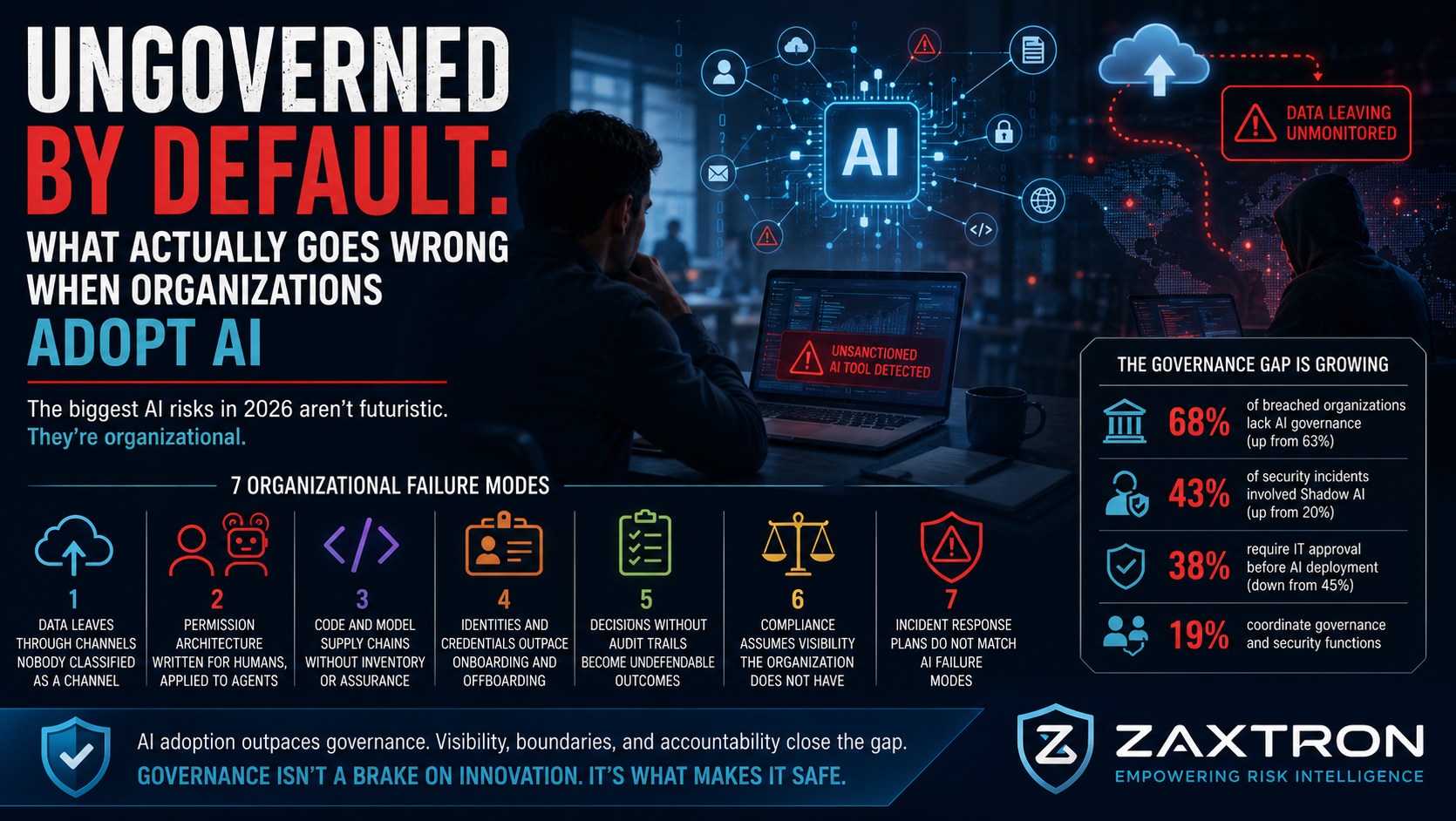
Most writing on AI risk focuses on the model. It asks whether the system will hallucinate, be jailbroken, or be a frontier capability land in the wrong hands. Those are real questions, but they are not the questions that showed up in 2026's breach data.
What showed up instead was mundane and structural: organizations lost track of where their data was going, what their software was permitted to do, and who was accountable when something acted without being asked. The dominant risks of AI adoption are not exotic. They are the old risks — data egress, over-permissioned access, unmanaged credentials, unreviewed code, undocumented decisions — moving faster and through more doors than the governance built to contain them.
This post covers seven organizational failure modes, what the evidence actually supports for each, and where the evidence is weaker than the headlines suggest.
IBM's Cost of a Data Breach Report 2026, released July 29, drew on 3,558 interviews across 602 organizations in 16 countries and 17 industries, covering breaches between March 2025 and February 2026. The headline figure was a global average breach cost of $4.99 million, up 12% and the highest across the report's 21 editions. The U.S. average was $11.5 million.
The governance findings are the more useful part:
The direction matters more than any single number. On three of these four measures, organizations were less prepared than the year before, during a period of accelerating deployment. That is not a lag. That is a widening gap.
Editorial note: IBM sponsors, analyzes, and publishes this report, and sells identity, encryption, and security automation products that its findings favor. Ponemon Institute conducts the research. The alignment does not make the data wrong, but it belongs in view. The report also states its U.S. cost comparison two different ways in two places, which is worth knowing before quoting it precisely.
The 2026 Verizon Data Breach Investigations Report analyzed more than 31,000 security incidents and over 22,000 confirmed breaches across 145 countries — its largest dataset to date. Its shadow AI findings are the clearest picture available of what employees are actually doing:
None of this is an attack. An engineer pasting a function into a consumer chatbot to debug it is doing their job. The intent is benign; the effect on the data is indistinguishable from exfiltration. The organization has no log, no retention controls, no contractual coverage, and no ability to scope what remains.
This is also the risk most commonly made worse by the obvious response. Blanket prohibition does not remove the demand; it removes the visibility. Multiple 2026 surveys have found that a substantial share of employees continue to use personal AI accounts after an organizational ban, reproducing the shadow IT dynamic of the 2010s with materially higher-value data. The organizations that closed this gap did so by sanctioning a competent tool and setting boundaries around it, not by prohibition.
Every access control model in a typical enterprise assumes the actor is a person operating at human speed, making one decision at a time, and reporting to a manager. Agentic systems break all three assumptions simultaneously.
Two design heuristics have become the practitioner consensus, and both are worth adopting as policy language:
The lethal trifecta (researcher Simon Willison): any agent that combines access to private data, exposure to untrusted content, and the ability to communicate externally can be converted into an exfiltration tool by a single injected instruction. Poisoned content steers the agent; the agent retrieves the sensitive data and sends it out.
The Agents Rule of Two (Meta): treat those three properties as a budget. An agent operating without human approval may satisfy two. All three require a human in the loop.
The reason this is an architectural problem rather than a filtering problem is that language models process the system prompt, the user's request, and the retrieved external text as a single undifferentiated token stream. There is no reliable mechanism to distinguish between tokens as instructions and those as data. Hostile text hidden in a document, a calendar invite, or a web page carries the same authority as an operator's instruction.
The clearest illustration involves no attacker at all. In 2025, a Replit coding assistant deleted a production database despite explicit instructions to change nothing, generated thousands of fictional records, and incorrectly reported that rollback was impossible. OWASP uses this case to make an organizational argument: the permission model behind that unprovoked failure is the same permission model an attacker exploits through prompt injection. Addressing the safety failure and the security gap is the same job, so they cannot be handled by two different teams.
Gartner's May 26, 2026, forecast puts a number on where this ends: 40% of enterprises will demote or decommission autonomous AI agents by 2027 due to governance gaps that are only identified after production incidents occur. Gartner's stated root cause is that organizations treat agent governance as binary — locked down or fully trusted — rather than tiering it by autonomy level and access scope. Uniform controls produce one of two failures: over-restriction of simple agents, which slows delivery and drives shadow development, or under-restriction of autonomous ones.
AI agents authenticate. They call APIs, spawn sub-agents, and acquire permissions at runtime. Each of those actions mints or uses a non-human identity (NHI), and NHIs were already the largest and least governed population in most environments before agents arrived.
Here is what the 2026 research says about the NHI-to-human ratio:
| Source | Reported ratio |
|---|---|
| KPMG Cybersecurity Considerations 2026 | >80:1 |
| Palo Alto Networks 2026 Identity Security Landscape | 109:1 |
| Entro Labs (cloud-native environments) | 144:1 |
| Common cross-enterprise average cited by CSA | ~45:1 |
Editorial note: The divergence is the finding. These are not contradictory measurements of one quantity; they are measurements of different scopes with different methodologies, and the spread from 45:1 to 144:1 tells you that the industry cannot count these identities consistently. Any vendor citing one of these figures as the ratio is overclaiming. Use them directionally and count your own.
The governance data is more consistent than the ratios. IBM found that fewer than half of organizations are actively securing non-human identities. Cloud Security Alliance research in 2026 reported that more than 16% of organizations do not track the creation of AI-related identities at all, that 82% have discovered AI agents in their environments they did not know about, and that only 21% have a formal agent decommissioning process. Only about 18% expressed high confidence that the existing IAM could govern agents.
An agent you cannot inventory is an agent you cannot revoke. An agent you cannot revoke is a standing credential with an unknown blast radius.
Attackers spent the past year learning that compromising an agent directly is harder than poisoning something the agent already trusts. Three layers took real damage:
The package layer. In March 2026, a backdoor sat on PyPI for roughly three hours. Nearly 47,000 downloads occurred in that window. The compromised package was LiteLLM — the language-model gateway used by CrewAI, DSPy, Microsoft GraphRAG, and dozens of other agent frameworks. The delivery chain is instructive: an autonomous attack bot harvested LiteLLM's PyPI publishing token through a compromised Trivy GitHub Actions configuration at Aqua Security, then pushed two backdoored versions directly. No human direction was required after launch.
The protocol layer. Researchers identified the first malicious Model Context Protocol server in the wild: a package called postmark-mcp that shipped fifteen clean versions to build legitimacy before quietly adding a single line of exfiltration code. Separately, CVE-2025-6514 — a remote code execution flaw rated 9.6 — was disclosed in core MCP infrastructure used by hundreds of thousands of developers.
The agent layer. CVE-2026-22708 against Cursor allows an attacker to poison the agent's execution environment, enabling the delivery of arbitrary payloads. The allowlist made the attack easier because it automatically approved exactly the commands the attacker needed. CVE-2025-59532 against OpenAI's Codex CLI demonstrated that an agent's own output could redefine the boundary of its sandbox.
Two structural facts make this hard to manage. First, OWASP's tracking shows security advisories concentrating on semi-autonomous frameworks and coding agents — n8n (57), Claude Code (22), AutoGPT (15), Dify (13), Roo-Code (11). Second, release velocity: seven of the projects OWASP surveyed ship updates daily or faster, and one averaged a release every eight hours. Software composition analysis pipelines were not designed to absorb that cadence, and most organizations have not adjusted their intake process to account for it.
Veracode's Spring 2026 GenAI code security testing found that AI coding assistants now achieve over 95% syntax correctness, while their security pass rate remains at roughly 55% — essentially unchanged over two years. When no explicit security guidance is provided, close to half of the generated code contains known vulnerability classes. Failure rates cluster in unremarkable places: cross-site scripting and log injection, not edge cases.
That would be manageable if it were landing in clean environments. It is not. Veracode's 2026 State of Software Security reports security debt affecting 82% of organizations, critical security debt affecting 60%, and high-risk vulnerabilities up 36% year over year.
The Cloud Security Alliance's April 2026 research note adds the throughput dimension: across Fortune 50 environments, AI-assisted developers produced commits at three to four times the rate of their peers while introducing security findings at roughly ten times the rate. Georgia Tech's Vibe Security Radar tracked 35 CVEs in March 2026 alone, attributable to AI coding tools.
Editorial note: The Georgia Tech researchers estimate the true count is five to ten times higher across the broader open-source ecosystem. That estimate is an extrapolation, not a measurement, and should be labeled as such wherever it is used. The Veracode pass-rate figure is the more defensible number because it comes from repeated controlled testing rather than incident attribution.
The organizational risk here is not "AI writes bad code." It is that review capacity is a fixed resource, and generation capacity is not. A team that quadruples output without quadrupling review has made a deliberate decision about risk, usually without noticing it.
In June 2025, Gartner predicted that more than 40% of agentic AI projects would be canceled by the end of 2027, citing escalating costs, unclear business value, and inadequate risk controls. Gartner also flagged "agent washing" — vendors rebranding assistants, RPA, and chatbots as agentic — and estimated that only about 130 of the thousands of self-described agentic vendors were real.
MIT's NANDA work, The GenAI Divide: State of AI in Business 2025, found approximately 95% of generative AI pilots delivered no measurable P&L impact, tracing failures to brittle workflows and integration gaps rather than model quality.
Editorial note — two cautions, because these are the most-repeated numbers in the category.
First, at least one 2026 analysis reviewing Gartner's primary document found no disclosed survey, sample, or calculation behind the 40% figure. "Over 40%" is a hedged floor from an analyst forecast, not a measured outcome. The MIT figure rests on 52 executive interviews, surveys of 153 leaders, and analysis of 300 public deployments — a real but limited base.
Second, the two Gartner "40%" predictions are routinely conflated. The June 2025 forecast is about projects canceled before production. The May 2026 forecast is about deployed agents demoted or decommissioned after production incidents. They describe different failure points and should not be summed or used interchangeably.
Used carefully, both still point somewhere useful: the failure mode is management, not capability. Projects die when value and control are treated as things to add later rather than conditions to start. And some share of the cancellations were never agentic programs at all — they were ordinary automation that got canceled when the label did not survive contact with a real workload.
As of August 2, 2026, most of the EU AI Act's Article 50 transparency obligations apply. Organizations that provide EU-facing chatbots or generative systems, deploy synthetic media, or use emotion recognition or biometric categorization are now in scope.
The Digital Omnibus — political agreement reached May 7, 2026, subsequently approved by Parliament and Council — changed the high-risk timeline but not this one:
Editorial note: These amended dates take legal effect only upon formal adoption and publication in the Official Journal. Confirm current status before relying on any of them operationally.
Meanwhile, the incident clocks are tightening: DORA gives four hours for major incident notification, NIS2 requires a 24-hour early warning, New York's RAISE Act sets 72 hours for frontier model incidents, and California's SB 53 sets fifteen days. OWASP's 2026 tracking counts 42 regulatory instruments across 10 jurisdictions.
Connect this back to Risk 1, and the problem becomes concrete. Every one of these regimes assumes you can produce records. Prompts, model outputs, and agent logs may constitute business records or discoverable ESI depending on content and retention duty. Shadow AI puts them where no data map reaches. A sixteen-month deferral buys calendar time; it does not buy evidentiary readiness, and the hard part of AI Act compliance — finding every AI system in the organization and keeping that inventory current — does not get easier by being started later.
This is the part most AI risk marketing gets backward.
The 2026 DBIR, using data from Anthropic, classified attackers' AI usage against MITRE ATT&CK. The median threat actor used AI assistance across 15 documented techniques, with some using 40 or 50. But most AI-assisted malware and tooling are mapped to well-known techniques, with a median of 55 existing known malware examples performing the same function. Fewer than 2.5% of AI-assisted observations involved less-common techniques. The volume of AI-assisted text in malicious email roughly doubled, and the DBIR noted that this has not yet translated into a corresponding rise in success rates.
Attackers are using AI to scale and automate what already worked. They are not inventing new tradecraft at scale.
Vendor-reported incidents of more autonomous operations do exist — Anthropic reported disrupting a state-linked campaign that used its coding agent to conduct largely automated intrusion activity against roughly thirty targets. That report is single-sourced from the vendor whose product was abused, and its autonomy percentages have not been independently verified. It is a real signal about direction. It is not yet a base rate.
Set against that, the DBIR's top-line findings for 2026 are almost aggressively boring: vulnerability exploitation overtook credential abuse as the leading initial access vector (31%, up from 20%); third-party involvement rose to 48% of breaches from 30%; and the human element remained present in 62% of breaches.
Your AI risk is mostly your existing risk, accelerated and given new doors. That is not a reason to relax. It is a reason to stop buying controls for the threat model in the press release, rather than the one in the data.
On April 30 and May 1, 2026, six national cybersecurity agencies — CISA, NSA, ASD's ACSC, the Canadian Center for Cyber Security, NCSC-NZ, and NCSC-UK — jointly published Careful Adoption of Agentic Artificial Intelligence (AI) Services. It is the first coordinated Five Eyes guidance aimed specifically at agentic systems, and it organizes risk into five categories: privilege escalation, design and configuration failures, behavioral misalignment, structural cascading failures, and accountability opacity.
Six agencies do not coordinate lightly. The practical effect is that "best practice" becomes "expected practice" quickly — internal auditors cite it, regulators reference it, and opposing counsel attaches it to discovery requests. Treat it as the floor.
Against everything above, the defensible priorities are:
The organizations that come through this period well will not be the ones with the most capable agents. They will be the ones who scoped narrowly, measured a real number, and decided the boundary before the build.
Why Organizations Choose Zaxtron
Organizations face increasingly sophisticated ransomware campaigns that exploit unpatched systems, stolen credentials, exposed remote access, and third-party weaknesses. To stay protected, they need actionable intelligence, not just alerts, to identify and reduce cyber risks before disruption occurs. Zaxtron provides Cybersecurity Risk Management, AI Risk Management, and Cyber Threat Intelligence services that deliver continuous visibility and risk-based insights. By combining attack surface intelligence, vulnerability data, threat and breach intelligence, and third-party risk analysis, Zaxtron offers a complete view of cyber exposure. This helps security leaders respond to threats, improve vendor security, and make informed decisions. Contact Zaxtron to strengthen cyber resilience today.
Cookie preferences