
Office Address
45 Ivan Allen Jr Blvd NW
Atlanta, GA 30308
Phone Number
+1 (888) 808-7330
Email Address
General: [email protected]
Sales: [email protected]
Support: [email protected]


45 Ivan Allen Jr Blvd NW
Atlanta, GA 30308
+1 (888) 808-7330
General: [email protected]
Sales: [email protected]
Support: [email protected]


 by Trurion Staffs
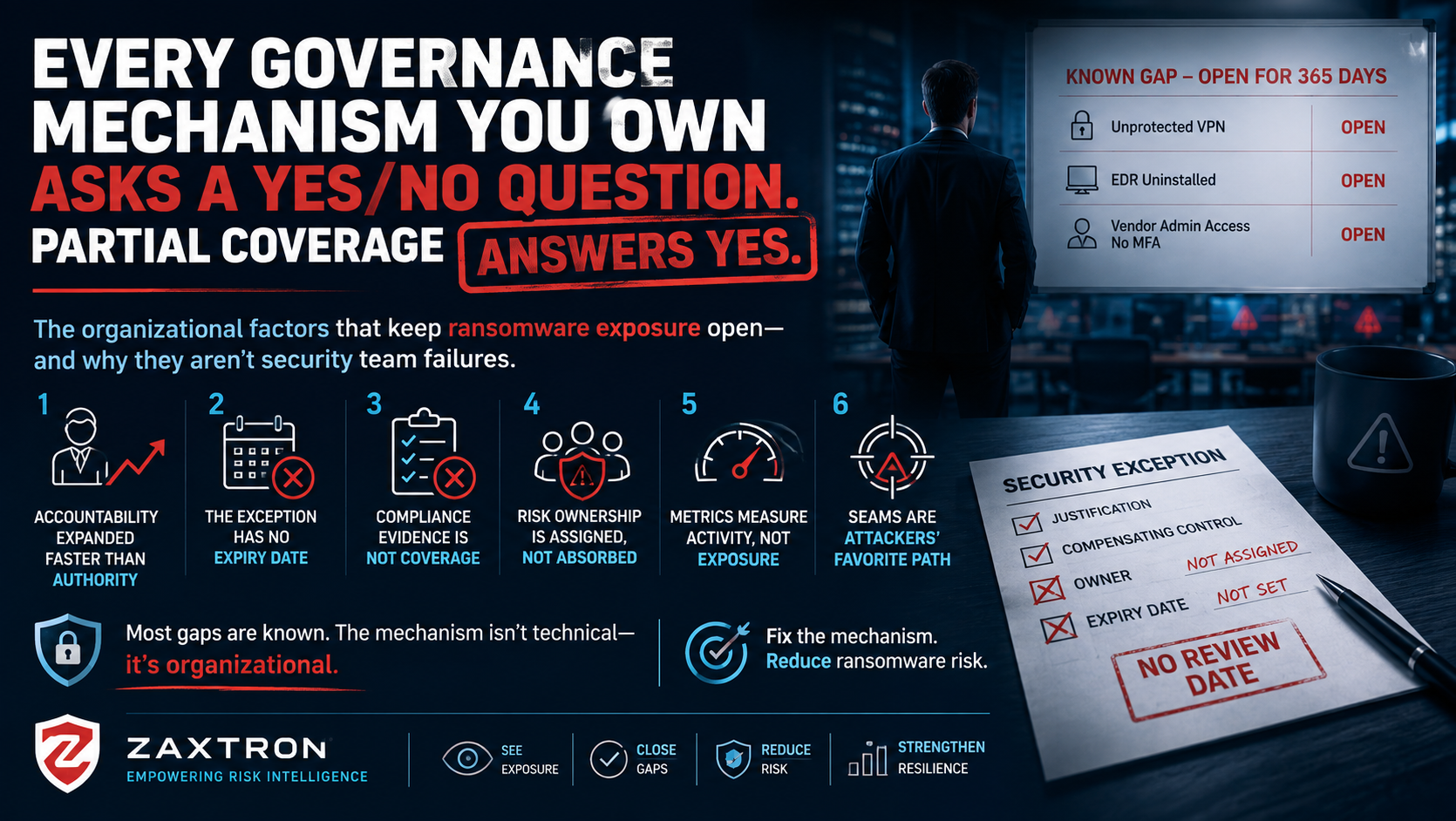
The organizational factors that keep ransomware exposure open — and why they aren't security team failures
Reading time: ~10 minutes | Audience: CISOs, security leadership, executive sponsors, board risk committees
Post-incident reviews are good at establishing what happened. An unprotected VPN. An EDR agent that had been uninstalled on a file server eighteen months earlier. A vendor account with standing administrative access and no MFA.
They are considerably worse at answering the more useful question: this gap was open for a year — what organizational mechanism kept it open?
That question has a better answer than most security leaders expect, and it is rarely "nobody noticed." A large share of ransomware victims were aware of the weakness. Sophos's 2026 survey found security gaps — known or unknown — cited as the leading operational root cause for the second consecutive year, at 62%, followed by lack of people or skills at 58% and lack of or poor-quality protection at 57%. Respondents cited multiple contributing factors, not one.
The word known is doing significant work there. In a meaningful share of cases, the gap had been identified, documented, and left open, which makes this an organizational problem rather than a detection one. The rest of this post covers the six conditions that produce that outcome, and the structural reason they are so persistent: almost every governance mechanism wrapped around security asks binary questions, and a partial rollout can answer them honestly with a yes.
The scope of the security leadership role has grown dramatically, and the data on that growth is unusually clear. Oxford Economics and Splunk surveyed 650 CISOs across nine countries and found that 96% now own AI governance and risk management, 85% own DevSecOps, and 67% are responsible for IoT, OT, and ICS security integration. Nearly four in five said the role became significantly more complex in the past year. Roughly three-quarters now worry about personal legal exposure for incidents on their watch, up from just over half a year earlier. Critically, the reporting indicates those mandates arrived without corresponding budget or headcount increases at most organizations.
The operational consequence is not abstract. Coverage gaps tend to appear precisely at organizational seams. The VPN concentrator is owned by the network team. The firewall management console is part of the infrastructure. The legacy application with the shared service account belongs to a business unit that funded it and resists change requests against it. Security owns the outcome on all three and controls the change calendar on none.
This is why "why didn't you just enable MFA on the VPN" is usually the wrong question. In most organizations, the security function cannot unilaterally enable anything on an asset another team operates and a third team's revenue depends on. What it can do is raise a finding, which brings us to the next factor.
Most coverage gaps do not begin as oversights. They begin as documented, justified, approved exceptions.
A legacy ERP system cannot support modern authentication without a vendor upgrade that is scheduled for next fiscal year. An OT segment cannot take the downtime required for patching outside a planned shutdown window. A managed service provider needs a standing account because their tooling does not support just-in-time access. Each of these is a defensible business decision at the moment it is made.
The failure is what happens next: the exception is recorded, the compensating control is described in general terms, no owner is named for its eventual closure, and no review date is set. Six months later, the vendor upgrade slips. The person who approved it has moved to a different role. The exception is now simply how the environment works.
This mechanism explains something the technical data alone cannot: the Verizon DBIR found that at day seven after detection, between 60% and 70% of known-exploited vulnerabilities remained open regardless of organizational maturity, investment, or team size — and that only 26% of known-exploited vulnerabilities were fully remediated, down from 38%. If well-resourced programs and constrained ones produce comparable numbers, effort is not the binding constraint. Institutional process is.
Practical fix, and it is genuinely cheap: every security exception gets a named human owner, a hard expiry date, and an automatic escalation to that owner's manager on expiry. Exceptions that cannot be closed are explicitly re-approved rather than by default. The organizations that do this find their exception register shrinks without anyone deploying new technology.
ISC2's 2025 Workforce Study, based on responses from a record 16,029 professionals, reported something worth pausing on: the organization stopped publishing its global workforce gap estimate, on the grounds that participants pointed to more specific measures of skills and staffing need than a headcount number captures.
The supporting figures explain why. 95% of respondents reported at least one skill need, up five points; 59% cited critical or significant skill needs, up fifteen points. 88% had experienced at least one significant cybersecurity consequence attributable to a skills shortage, and 69% had experienced more than one. On resourcing: 33% said their organization lacked the resources to staff teams adequately, 29% said they could not afford to hire people with the skills they actually needed, and 72% agreed that reducing security headcount materially increases breach risk.
The distinction between headcount and skills matters operationally. Closing an identity coverage gap across VPN, firewall consoles, service accounts, and legacy applications requires identity governance expertise, specifically, not general security capacity. An organization can be adequately staffed by headcount and still have no one who can safely re-architect authentication on a system that predates the current directory.
This is also the honest case for external capability. It is not that internal teams are inadequate. It is that certain gaps require depth that a generalist team of any size will not have on staff, and hiring for it takes six to nine months in a market where the specific expertise is scarce.
Nearly half of ISC2 respondents (48%) reported exhaustion from trying to stay current with threats and emerging technology, and 47% reported feeling overwhelmed by workload. Independent surveys align: Bitsight's 2025 work found 47% of risk and security professionals reporting some degree of burnout, and Proofpoint's Voice of the CISO found 63% of CISOs had experienced or witnessed burnout.
The security consequence of burnout is not usually a missed alert during an incident. Incident response is adrenal, visible, and prioritized. What degrades first is unglamorous continuous maintenance:
Every item on that list is a mechanism by which a control that was genuinely complete becomes a control that is merely mostly complete. Coverage does not just fail to reach the hard systems. It erodes from the systems it had already reached.
The DBIR identified shadow AI as the third most common non-malicious insider action in its data loss prevention dataset, a fourfold increase in proportion year over year. [Confirmed] Third-party involvement reached 48% of confirmed breaches, up from 30%. [Confirmed] And the remediation data behind that is the part with governance implications: only 23% of third-party organizations had fully remediated missing or improperly secured MFA on cloud accounts, with weak passwords and permission misconfigurations taking a median of eight months to resolve half of the findings.
Eight months exceeds most vendor review cycles. An annual questionnaire samples a posture that changes on a slower clock than the review that measures it.
The same pattern applies internally to any inherited estate — acquisitions, subsidiaries operating under local IT, and business units that procured SaaS independently. Each arrives with its own identity infrastructure, its own exception history, and its own definition of "MFA is enabled." Integration timelines are set by deal economics, not security readiness. The WEF's Global Cybersecurity Outlook 2026, drawing on 804 participants across 92 countries, frames this as a widening divide between organizations with mature governance and those without, with skills shortages and resource constraints amplifying the gap.
Here is where the factors converge into something more than a list.
Boards, auditors, regulators, and cyber insurers all now demand evidence rather than assertion. That is progress. But look at the shape of what they ask for. Insurance underwriting questionnaires in 2026 are structured around a recognizable set of controls — MFA for remote access, email, and privileged accounts; EDR or MDR coverage; immutable, restore-tested backups; a documented and exercised incident response plan; and patch management. [Reported] Carriers increasingly verify independently rather than accept attestation, and claim disputes now turn on whether the attested control was actually enforced at the time of loss.
Note the failure mode this creates. The question "Is MFA enforced on remote access?" is answered truthfully with a yes by an organization whose coverage stops at 70%. The question is binary. The environment is not. The organization is not lying; the format cannot express the shape of its exposure.
Board reporting has the same property. As one bank CISO put it at a June 2026 industry panel, boards fund evidence of business risk reduction rather than vulnerabilities. [Reported] Evidence of risk reduction is easiest to produce for newly acquired capability — a tool deployed, a program launched, a certification achieved. It is far harder to produce for the unglamorous completion work that closes the last 30% of an existing rollout, which shows up in no procurement cycle and generates no launch announcement.
So the funding mechanism, the insurance mechanism, and the board reporting mechanism all point in the same direction: toward acquiring controls and away from finishing them. That is the structural reason coverage gaps persist, and it is not a failure of the security team. It is a measurement failure that the security team inherited.
These are governance changes, not purchases. Most cost nothing but attention.
Why Organizations Choose Zaxtron
Organizations face increasingly sophisticated ransomware campaigns that exploit unpatched systems, stolen credentials, exposed remote access, and third-party weaknesses. To stay protected, they need actionable intelligence, not just alerts, to identify and reduce cyber risks before disruption occurs. Zaxtron provides Cybersecurity Risk Management, AI Risk Management, and Cyber Threat Intelligence services that deliver continuous visibility and risk-based insights. By combining attack surface intelligence, vulnerability data, threat and breach intelligence, and third-party risk analysis, Zaxtron offers a complete view of cyber exposure. This helps security leaders respond to threats, improve vendor security, and make informed decisions. Contact Zaxtron to strengthen cyber resilience today.
Security teams are rarely unaware of the gaps that get used against them. Sixty-two percent of ransomware victims cited security gaps, known or unknown, as an operational root cause.
Those gaps stay open because accountability expanded past authority, because exceptions are granted without expiry, because the specific expertise required is scarce and the generic capacity is exhausted, because complexity arrives on business timelines rather than security ones, and above all, because every mechanism that measures security posture asks binary questions that partial coverage can answer honestly with a yes.
The organizations that close this do not start by buying anything. They start by changing the question's shape.
Cookie preferences