
Office Address
45 Ivan Allen Jr Blvd NW
Atlanta, GA 30308
Phone Number
+1 (888) 808-7330
Email Address
General: [email protected]
Sales: [email protected]
Support: [email protected]

45 Ivan Allen Jr Blvd NW
Atlanta, GA 30308
+1 (888) 808-7330
General: [email protected]
Sales: [email protected]
Support: [email protected]


 by Trurion Staffs
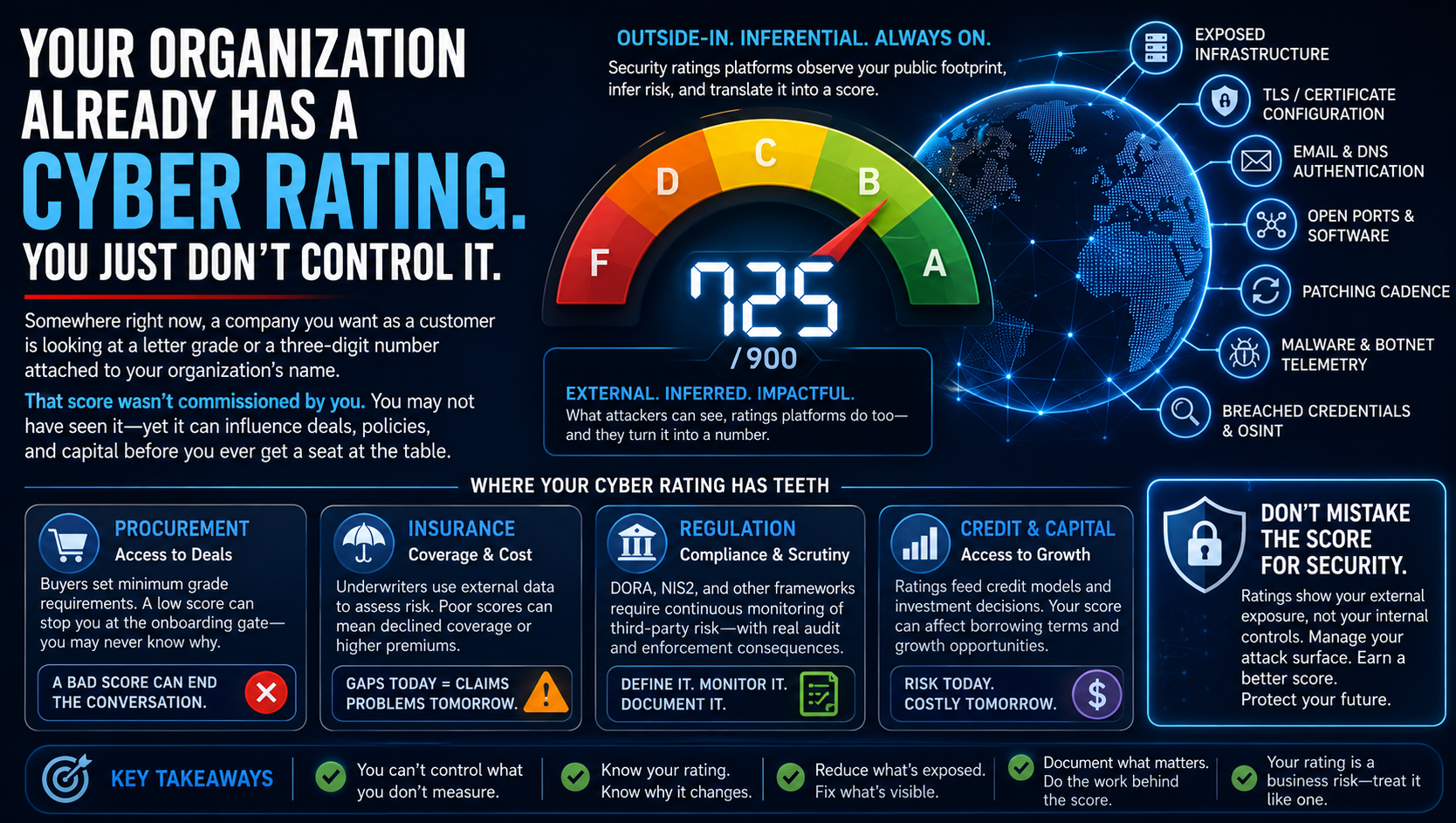
Somewhere right now, a company you want as a customer is looking at a letter grade or a three-digit number attached to your organization's name. You did not commission it. You may not have seen it. You almost certainly were not asked to verify the underlying data.
That is the defining feature of the organizational cyber rating: it is a reputational asset generated about you rather than by you, and increasingly it sits between your organization and the deals, policies, and capital it needs.
The rating market has existed since Bitsight commercialized the idea in 2011. What has changed is not the technology but the number of decisions now routed through it. In 2026, a low score can stall a procurement cycle, price a cyber insurance renewal, land in a regulator's third-party register, and feed a credit analyst's model — often without anyone at your organization being in the room.
Security ratings platforms are, at their core, outside-in observation engines. They assemble a picture of your organization from data that is visible without your permission: internet-facing infrastructure, certificate and TLS configuration, DNS and email authentication records (SPF, DKIM, DMARC), open services and exposed software versions, patching cadence inferred from banner data, botnet and malware telemetry collected via sinkholes and honeypots, credentials appearing in breach corpora, and open-source intelligence.
The platforms then attribute those observations to an organization by mapping IP ranges, domains, and subsidiaries, weighting the findings, and normalizing the results onto a scale — Zaxtron Trurion's 0 - 100, Bitsight's 250–900 range, SecurityScorecard's A–F, Black Kite's A–F Cyber Grade, RiskRecon's 0–10.
Two properties of this model matter more than the scoring math.
It is passive. The major first-generation platforms observe; they do not actively probe your environment, run authenticated scans, or verify that a control you claim to operate is functioning. What they see is what an attacker doing reconnaissance would see — which is genuinely useful, and genuinely partial.
It is inferential. A rating infers internal discipline from external hygiene. An organization that leaves expired certificates and unpatched edge appliances on the public internet is probably not running a tight patch program internally. That inference is reasonable. It is not evidence.
Minimum-grade requirements are now written into the vendor onboarding policy. A common pattern is a hard floor — a B or better — enforced at the onboarding gate, with tiered review cadence keyed to criticality. Security ratings vendors actively encourage this framing, and buyers have adopted it because it scales in a way that questionnaires do not.
The practical consequence is asymmetric. A good score rarely wins a deal on its own. A bad score can end one's career before a security review ever happens, and you may never learn that was the reason.
Cyber underwriting has moved from questionnaire-based to evidence-based. Carriers increasingly run external attack surface scans before quoting, drawing on commercial ratings data or their own scanning infrastructure, and a poor external posture can produce a decline or a materially worse price.
The market context is contested. S&P Global Ratings has projected global cyber premiums to reach around $23 billion by the end of 2026, growing 15–20% annually from roughly $14 billion at year-end 2023; Swiss Re's estimates are considerably lower, at around $15.6 billion for 2025 and $16.4 billion for 2026. The estimates diverge because the scope definitions do. What is not contested is the direction of underwriting scrutiny: more technical verification, less reliance on self-attestation.
There is a second-order risk worth naming. Where coverage is issued on the strength of represented controls, a gap between what was represented and what was maintained becomes a claims-time problem — the organization pays premiums, believes it is covered, and discovers otherwise at the worst possible moment.
European regulation has made third-party posture an auditable artifact rather than a matter of internal judgment.
DORA has applied to EU financial entities since 17 January 2025. It requires a Register of Information covering every ICT contractual arrangement, pre-contractual due diligence proportionate to criticality, continuous monitoring of active relationships, and documented exit strategies for critical or important functions. The second annual register submission cycle ran to the European Supervisory Authorities by 31 March 2026, and supervisors have signaled that persistent register deficiencies are an enforcement priority. Designated critical ICT third-party providers face penalty payments of up to 1% of average daily worldwide turnover.
NIS2 imposes supply chain security obligations on essential entities across 18 sectors, with national transposition laws now in force in most EU jurisdictions.
In the United States, the SEC's rules require disclosure of material cybersecurity incidents on Form 8-K Item 1.05 within four business days of a materiality determination, and annual Item 106 disclosure of risk management and governance processes — including how the company oversees third-party risk. Item 1.05 is under active pressure: banking trade associations have petitioned for rescission, and rescission or substantial reform was among the most frequently requested changes in comment letters in response to the SEC's January 2026 Regulation S-K review. As of this writing, the rules stand, but the disclosure regime is not settled.
Editorial note: the SEC position above is accurate as of mid-2026 and should be re-verified before publication if the post ships after that date.
This is the channel most organizations underestimate. Moody's Ratings has published an analysis finding that 28% of collectively rated debt — $22.3 trillion — carries high or very high cyber risk exposure, and Moody's has a strategic partnership with Bitsight that integrates cybersecurity ratings into Orbis, Credit Catalyst, Supply Chain Catalyst, and other products. S&P Global Ratings has a comparable relationship with Guidewire's Cyence Risk Analytics.
Neither agency treats cyber as a principal driver of ratings. Moody's long-standing position is that it views material cyber threats as an extraordinary event risk — closer to a natural disaster than a structural credit factor — with impact determined by severity and duration. But the plumbing is now in place for external cyber scores to inform credit analysis, and that plumbing did not exist a decade ago.
The reason organizational ratings became load-bearing is that third-party compromise stopped being an edge case.
Verizon's 2026 DBIR found third-party involvement in 48% of analyzed breaches — a 60% year-over-year increase, following a year in which the figure had already doubled from 15% to 30%. Third-party involvement now matches ransomware's share of total breaches.
Black Kite's 2026 Third-Party Breach Report analyzed 136 verified third-party breach events from 2025 and found an average of 5.28 downstream victims per incident, the highest recorded and up from 2.56 the prior year. Seven hundred and nineteen companies were publicly named; roughly 26,000 more were disclosed only in aggregate and never identified. Median detection ran to about 10 days; average delay to public disclosure, 117.
The World Economic Forum's Global Cybersecurity Outlook 2026 found 65% of large companies by revenue naming third-party and supply chain vulnerabilities as their greatest challenge to resilience, up from 54% the previous year.
Read those numbers from the other side of the table. Every organization in your customer base is now under pressure — commercial, regulatory, and insurance — to demonstrate that it monitors you. The rating is the cheapest available instrument for doing that at scale. Your score is not primarily a report card. It is an input to somebody else's compliance evidence.
The predictive claim deserves scrutiny, because most of the evidence supporting it originates with the vendors selling ratings.
SecurityScorecard has reported that organizations rated F are 13.8 times more likely to experience a breach than those rated A, and that its Scoring 3.0 model was built by weighting more than 200 issue types against roughly 15,000 breaches over four years. Bitsight points to work, including "Risky Business: Assessing Security with External Measurements" by Jacobs, Forrest, and Edwards, research whose lead author was a former Bitsight data scientist.
These are directionally credible and structurally self-interested. The more useful evidence comes from third parties with no commercial stake. A 2021 study published in the Journal of the American Medical Informatics Association used Bitsight ratings, supplied by permission and without financial support, to model breach probability among U.S. hospitals and found meaningful variation in predicted breach risk across rating bands — with the authors noting that the overall security rating captured human as well as technical factors better than a narrower compromised-systems measure.
The honest summary: externally observable hygiene correlates with the likelihood of breaches at the population level. That is a real finding, and it is why the market exists. It is also a statistical statement about thousands of organizations, not a prediction about one.
Attribution error. The single most common operational complaint. Ratings platforms map internet assets to organizations algorithmically, and the mapping breaks in predictable ways: shared hosting, cloud IP ranges reassigned between tenants faster than attribution data updates, acquired subsidiaries and divested business units, third-party marketing infrastructure branded with your domain. Security teams routinely find their scores dragged down by infrastructure they do not own, and disputes can take weeks.
Staleness. A finding can persist in a score after the underlying issue is remediated, depending on rescan cadence and dispute throughput.
Blindness to what matters most. Ratings cannot see your identity architecture, privilege model, segmentation, logging coverage, or incident response capability. The 2026 DBIR is emphatic that recent high-profile third-party cloud incidents hinged on insecure authentication and the absence of least-privilege enforcement — only 23% of third-party organizations had fully remediated missing or misconfigured MFA on cloud accounts, and the median time to resolve half of weak-password and permission findings approached 8 months. Almost none of that is externally observable.
False confidence — the real hazard. False positives are irritating; false assurance is dangerous. A vendor with a strong grade can still be the entry point, and Black Kite's own data makes the point uncomfortably well: 2025 saw a record third-party breach scale, while the average Cyber Grade across the roughly 200,000 organizations it monitors remained strong. Aggregate scores stayed healthy, and the ecosystem broke anyway.
Score management is not security. Because ratings weigh what they can see, effort naturally migrates toward what moves the number. Closing a low-risk finding that costs three points is not equivalent to fixing an identity gap that the platform cannot detect. Both belong in the program, but only one of them is why you have a program.
Claim and correct your attribution first. Register with the major platforms, review the asset inventory each assigns to you, and dispute anything that is wrong. Most organizations that receive a bad score also find an inaccurate asset map. This is the highest-return hour you will spend.
Monitor the score you present, not just the score you hold. Check what a prospect sees. Ask a friendly customer to share the scorecard they hold on you. The view differs by platform, and the platform your largest customer uses is the one that matters.
Treat the trajectory as the signal. A steady 78 and a 78 that was 90 twelve weeks ago describe very different organizations. Boards and customers respond to direction more than level, and direction is harder to game.
Build a standing dispute-and-remediation loop. Assign an owner, define an SLA for triaging new findings, and track dispute outcomes. Ratings decay and refresh on the platform's schedule, not yours — the only lever you control is submission speed.
Instrument the gap deliberately. Write down what your rating cannot see — MFA coverage on privileged and cloud accounts, credential rotation, least-privilege enforcement, segmentation, log retention, tested recovery — and evidence those separately. That evidence is what a serious customer asks for after the score passes the gate, and what DORA-scope customers will require in writing.
Use the rating as a trigger, not a verdict. For your own vendors, a score change should open an inquiry, not close one. Score plus criticality determines depth of review; score alone determines nothing.
Prepare the narrative before you need it. When a score drops, the question from procurement arrives within days. An organization that can explain what happened, what is being remediated, and the timeline retains the deal. An organization that goes quiet loses it — not because of the finding, but because of the silence.
Cyber ratings are an imperfect proxy that the market has decided to treat as a credential. Arguing with that is unproductive; the score is being used whether or not it deserves the weight.
The workable posture is to hold two ideas at once. Externally, the rating is a reputational asset that requires active management, accurate attribution, and a ready explanation. Internally, it is a floor, not a ceiling — a measure of the hygiene an attacker can see from the outside, which is precisely the part of your security program that was never the hard part.
The organizations that come out ahead are the ones that fix the underlying exposure because it is exposure, and let the score follow. The ones that get burned are the ones that learn to optimize the number and mistake the optimization for the outcome.
Why Organizations Choose Zaxtron
Organizations face increasingly sophisticated ransomware campaigns that exploit unpatched systems, stolen credentials, exposed remote access, and third-party weaknesses. To stay protected, they need actionable intelligence, not just alerts, to identify and reduce cyber risks before disruption occurs. Zaxtron provides Cybersecurity Risk Management, AI Risk Management, and Cyber Threat Intelligence services that deliver continuous visibility and risk-based insights. By combining attack surface intelligence, vulnerability data, threat and breach intelligence, and third-party risk analysis, Zaxtron offers a complete view of cyber exposure. This helps security leaders respond to threats, improve vendor security, and make informed decisions. Contact Zaxtron to strengthen cyber resilience today.
Cookie preferences